

Essential oil authenticity is a growing concern as global demand rises and adulteration—through dilution, synthetic additives, or substitution—becomes increasingly common. Conventional testing methods such as GC-MS provide detailed chemical profiles but require time-intensive separations. Molecular Rotational Resonance (MRR) spectroscopy offers a fundamentally different approach by directly measuring gas-phase rotational spectra unique to each terpene component. This enables rapid, selective detection of adulteration without chromatographic separation.
What makes essential oils susceptible to adulteration?
Definition: Essential oils are complex mixtures dominated by monoterpenes and oxygenated derivatives, each with unique molecular structures and characteristic aroma profiles.
Detail: Because natural oils command premium pricing, they are frequently diluted with inexpensive carrier oils or modified using synthetic analogs that mimic aroma but alter chemical composition. These differences can be subtle and difficult to distinguish using bulk analytical techniques.
Example: Peppermint oil adulteration may involve blending with synthetic menthol or diluting with low-cost oils, which alters terpene ratios essential for authenticity assessment.
How does MRR identify adulteration in essential oils?
Definition: MRR spectroscopy measures rotational transitions of gas-phase molecules, producing highly specific “fingerprints” for each compound.
Detail: Because terpenes have unique rotational spectra, MRR can distinguish them based on structural differences. The app note highlights that intensity variations across the 8–12 GHz region provide clear signatures associated with authentic peppermint oil, diluted samples, and synthetic materials. Even isomeric terpenes exhibit differentiable spectral features under MRR.
- Authentic peppermint oil shows strong, well-distributed spectral lines.
- Dilution reduces overall intensity while preserving relative patterns.
- Synthetic mixtures alter terpene abundance ratios entirely.
Example: MRR can differentiate a 50:50 authentic/synthetic blend by its intermediate intensity distribution, distinct from either pure component.
How does MRR compare to GC-MS for authenticity testing?
Definition: GC-MS separates terpenes by retention time before mass detection, while MRR characterizes compounds directly in the gas phase without separation.
Detail: The app note demonstrates strong correlation between MRR signal intensity and GC-MS peak areas for key peppermint terpenes. This confirms that MRR captures compositional changes relevant to authenticity testing with much faster analysis times.
- No chromatographic separation or columns required
- Direct measurement of rotational transitions unique to each terpene
- Fast data acquisition suitable for high-throughput screening
Example: GC-MS may require 20–40 minutes per run, while MRR collects spectral data rapidly from vaporized samples.
How does MRR detect diluted and synthetic peppermint oil?
Definition: Adulteration changes the absolute and relative spectral intensities of key terpene components.
Detail: The app note highlights three sample types—authentic peppermint oil, a diluted sample, and a synthetic formulation. MRR captures clear intensity differences: the diluted sample shows reduced global intensity, while the synthetic sample exhibits a different terpene profile entirely.
Example: When plotted, the diluted oil spectrum retains similar peak shapes to authentic material but at lower intensity, while the synthetic oil shows unique spectral features reflecting its altered composition.
What does the data reveal about analytical performance?
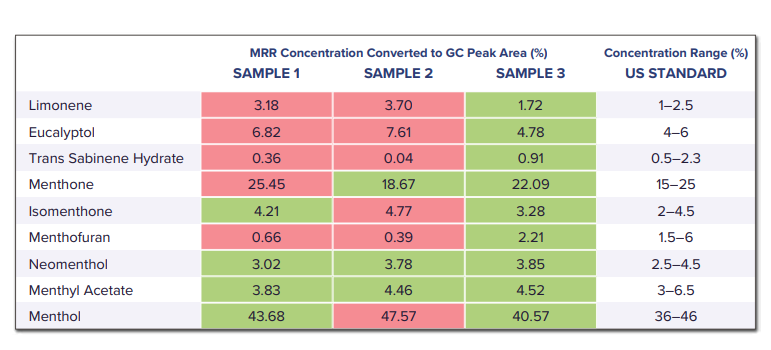
The app note includes quantitative comparison data demonstrating MRR’s ability to differentiate peppermint oil samples based on normalized intensity behavior. Table 3 summarizes MRR-derived intensity ratios and their relationship to known authentic, synthetic, and blended formulations.
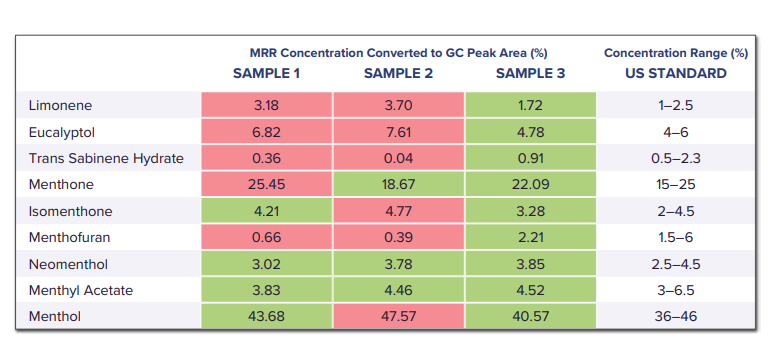
The table above illustrates the compliance of three peppermint oil samples (SAMPLE1, SAMPLE2, and SAMPLE3) with US specifications, highlighting variations in key terpene components and their implications for authenticity assessment.
Example: The 50:50 authentic/synthetic blend shows intermediate values across the measured spectral regions, aligning with expectations for adulterated material.
What workflow does MRR use for essential oil authentication?
Definition: MRR relies on minimal sample preparation and automated spectral acquisition.
Detail: According to the app note’s workflow illustration, samples are diluted in methanol, introduced into the MRR system, and analyzed directly as vapor. Because MRR detects rotational transitions without chromatographic separation, the process avoids consumables, derivatization, and long run times.
- Dilution in methanol
- Vapor-phase introduction
- Automated spectral acquisition
- Direct interpretation of intensity-based authenticity signatures
Example: This workflow is well suited for screening large batches of essential oil samples for quality control or supply-chain authentication.
Can MRR scale for routine authenticity programs?
Definition: Essential oil authentication often requires screening multiple batches or suppliers to ensure consistency.
Detail: Because MRR collects data in minutes and requires minimal preparation, it can be deployed in QC environments or integrated into high-throughput authentication workflows. The method’s sensitivity to structural differences makes it particularly valuable for detecting subtle shifts in terpene composition.
- Supports batch-level verification
- Reduces analysis time versus GC-MS
- Provides consistent terpene profiles across analyses
- Facilitates rapid detection of adulterated or synthetic materials
Example: Manufacturers or distributors can use MRR as a fast screening tool before sending select samples to GC-MS for confirmatory analysis.
Conclusion: A faster path to essential oil authenticity
MRR provides a powerful, rapid method for evaluating the authenticity of essential oils. By measuring unique rotational spectra that reflect terpene composition, MRR distinguishes authentic peppermint oil from diluted and synthetic alternatives with high specificity and minimal preparation. The strong correlation with GC-MS data and rapid acquisition make MRR an efficient alternative or complement to chromatographic techniques—ideal for modern authenticity programs seeking speed, accuracy, and scalability.
Frequently Asked Questions
Why is essential oil authenticity testing important?
Essential oils are frequently adulterated with synthetic substitutes or low-cost diluents. Authenticity testing ensures product integrity, consumer trust, and regulatory compliance.
How does MRR detect adulteration in essential oils?
MRR measures rotational spectra that uniquely identify individual terpenes. By comparing spectral intensity patterns, MRR distinguishes authentic oils from diluted or synthetic materials.
What makes MRR different from GC-MS for oil authentication?
MRR does not require chromatographic separation and can resolve structural isomers with high specificity. This enables faster workflows and clearer differentiation of terpene profiles.
Can MRR detect both dilution and synthetic adulteration?
Yes. Dilution reduces overall spectral intensity, while synthetic compositions alter terpene ratios. MRR quantifies both effects using direct gas-phase measurements.
What sample preparation does MRR require?
Samples are diluted in methanol and analyzed in the gas phase using headspace introduction—no derivatization required.