

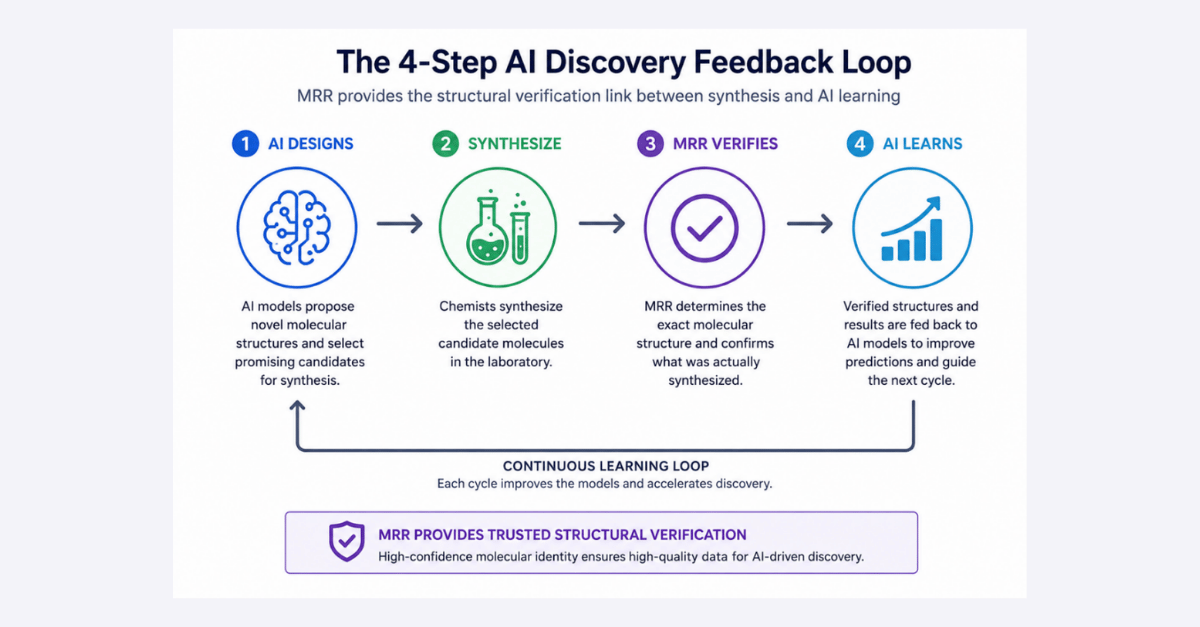
Artificial intelligence is rapidly changing how scientists design new molecules. Before a compound is ever synthesized, AI and computational models can propose novel molecular structures, predict properties, and help prioritize candidates. What once required extensive cycles of experimental trial and error can now begin computationally. As the ability to generate and predict new molecules rapidly accelerates, other challenges become increasingly important: how do we know when the model is right (or wrong), and how do we know the right molecule has been made when no standards for it exist?
Computational prediction is ultimately a hypothesis about physical reality. No matter how sophisticated the model, experimental evidence must eventually test its predictions. This matters most as AI moves beyond the well-characterized chemical space and proposes molecules that have never been synthesized or studied before.
The next challenge in AI-driven chemistry will therefore extend beyond the design of better molecules. It requires building a faster, more direct connection between the computational prediction and the experimental measurement. Molecular Rotational Resonance (MRR) spectroscopy provides that link by allowing a computationally predicted structure to be tested experimentally.
Connecting a Predicted Structure to an Experimental Measurement
A molecule's three-dimensional structure determines its rotational spectrum, which can be predicted computationally using quantum chemistry. Researchers can then compare the predicted spectrum to the spectrum measured from the synthesized molecule. This creates a direct bridge between the computational and physical domains: a proposed molecular structure translates into a predicted rotational spectrum, which can then be tested against an experimental measurement.
Subtle changes in molecular structure produce large changes in rotational spectra. Differences in atomic arrangement, substitution, or three-dimensional configuration therefore generate easily distinguishable spectral signatures. This matters especially for AI-designed molecules. The most interesting candidates have likely never been synthesized or measured before, so reference standards and experimental spectral libraries do not exist. With MRR, the proposed structure itself provides the starting point: quantum chemistry predicts the rotational spectrum expected for that structure, and experiments test whether those predicted signatures are present in the molecule that was actually made.
This workflow answers a fundamental question about a novel molecule: does the structure that exists experimentally match the structure predicted computationally? The answer also tests the model that made the prediction.
A Self-Improving Predict-Measure Loop
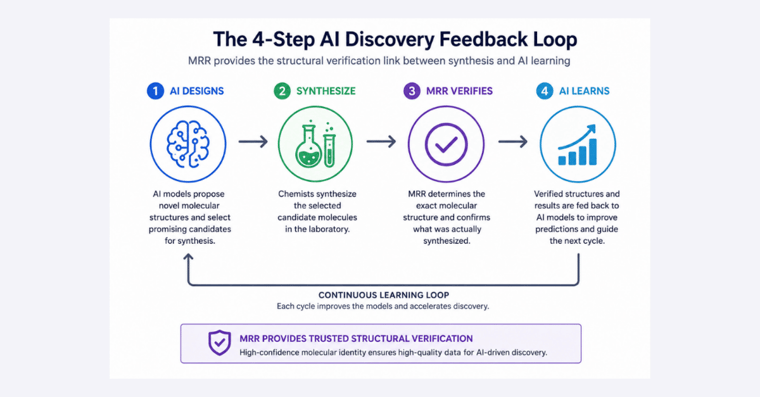
Experimental structural validation provides the critical link between computational prediction and the structure of the synthesized molecule, creating a continuous cycle of predict, make, measure, and learn. AI and computational models generate candidate molecular structures and predict their properties. Researchers then synthesize those molecules and work to confirm that the experimental structure matches the original prediction.
From Structural Validation to Better Models
Comparing a predicted structure with the experimentally observed molecule provides an important feedback point. When prediction and experiment agree, the result provides confidence that the proposed structure was successfully realized. When they disagree, the result identifies a discrepancy that can be investigated further.
This feedback becomes more important as computational models explore increasingly novel chemical space. Experimentally validated structural data can provide a source of ground truth for evaluating structure predictions and, together with other experimental data points, inform future model refinement or training. In this way, structural validation becomes part of model development, rather than simply a final check on the synthesized molecule.
Accelerating the Simulation-to-Reality Cycle
The rapid expansion of AI-proposed molecular candidates means the ability to generate reliable experimental feedback must keep pace. The opportunity lies in shortening the distance between a molecular proposal, its physical creation, and the evidence needed to determine whether the prediction was correct.
MRR offers a unique advantage within this cycle: molecular structure links through quantum mechanics to an experimentally measurable rotational spectrum. This connection enables structural validation even for novel molecules where reference standards or previously measured spectra do not exist.
At BrightSpec, we see experimental structural measurement becoming an integral part of the AI-driven molecular discovery ecosystem, not simply as a final confirmation step, but as part of a continuous exchange between prediction and experiment. AI can help determine what molecules we should make next. Experiment can tell us what we actually made and whether it matches the structure we set out to make. Closing that loop turns a prediction into proof.