

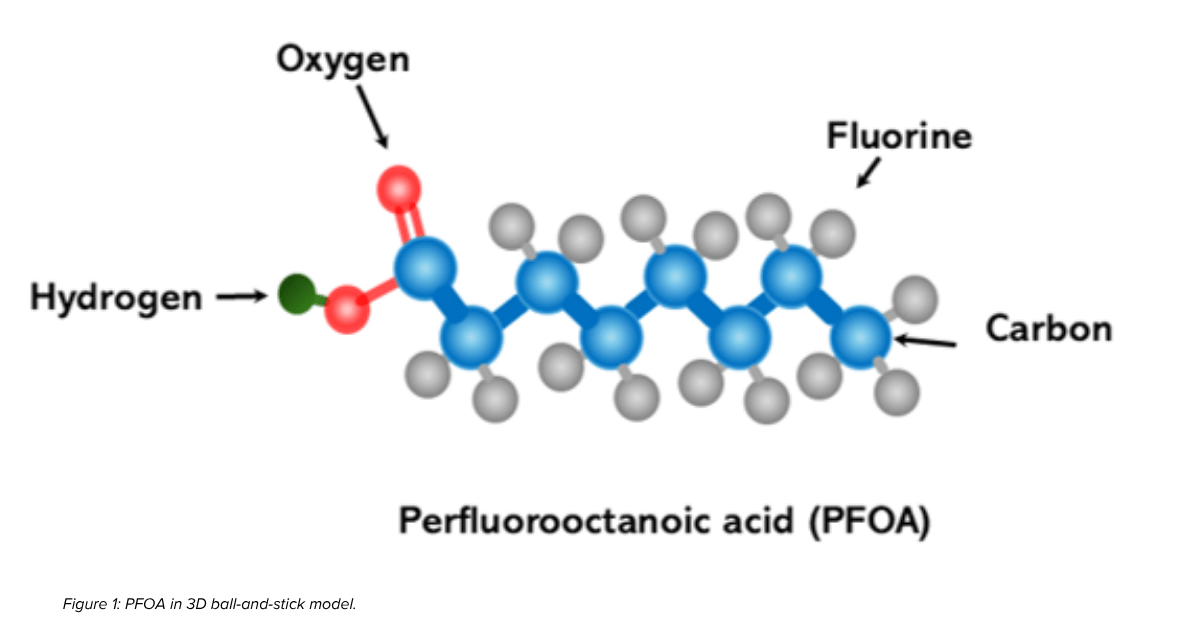
Per- and polyfluoroalkyl substances (PFAS) are among the most challenging molecules in modern analytical chemistry. They are persistent, mobile, toxic at parts-per-trillion levels, and now tightly regulated. The analytical question is no longer just "Is PFOA present?" but "Was it destroyed?" and, if so, into what?
This challenge is not academic. PFOA, a perfluorinated carboxylic acid with a fully fluorinated eight-carbon chain and terminal carboxyl group, is one of the six “forever chemicals” recently regulated by the U.S. Environmental Protection Agency (EPA) in drinking water [1,2]. Its amphiphilic structure, hydrophobic fluorinated tail plus hydrophilic carboxyl head, gives it exceptional surfactant value for surface treatments, food packaging, firefighting foams, lubricants, electrical insulation, and fluoropolymer production such as PTFE [2–4], all stabilized by very strong C–F bonds.
That same stability makes PFOA extremely persistent: it resists hydrolysis, photolysis, and biodegradation, contaminates groundwater and local air, accumulates in ecosystems and living organisms, and has been linked to kidney and testicular cancers [2,5,6], with the International Agency for Research on Cancer (IARC) listing PFOA as carcinogenic to humans (Group 1, 2023; Group 2 in earlier evaluations) [7,8]. Even hydration matters, as recent molecular rotational resonance (MRR) work on PFOA monohydrate (PFOA–H2O) shows, water inserts into the acid hydrogen-bonding network to form a stable cyclic complex, altering the conformational energy landscape and thus PFOA’s stability, reactivity, and environmental fate in aqueous environments [9]. Highly selective techniques capable of probing these weakly bound complexes, conformers, and trace residues in complex environmental matrices are therefore highly desirable [9,10].
In recent work, BrightSpec has been building a molecular rotational resonance (MRR) library and targeted method for perfluorooctanoic acid (PFOA) and its proposed step-wise decomposition products, enabling direct detection of PFOA decomposition products, including perfluoroheptanoic acid (PFHpA, C7), perfluorohexanoic acid (PFHxA, C6), perfluoropentanoic acid (PFPeA, C5), and perfluorobutanoic acid (PFBA, C4). We were able to directly detect PFOA, C8HF15O2, 414.07 Da, by MRR, plus resolve its shorter-chain homologs as distinct fingerprints. Because that fingerprint is determined directly by 3D structure, MRR delivers definitive ID in minutes, validated against quantum-predicted spectra without needing a reference standard for every species. That pushes MRR well into the semi-volatile PFAS range and opens a derivatization-free, chromatography-free path for remediation monitoring.
[Want to learn more about BrightSpec's MRR applications? Join our newsletter.]
Why PFOA Decomposition Products Matter
Thermal and chemical destruction aim to mineralize PFOA to CO2 and fluoride, but proceed stepwise:
PFOA (C8, 414 Da) → PFHpA (C7) → PFHxA (C6) → PFPeA (C5) → PFBA (C4)
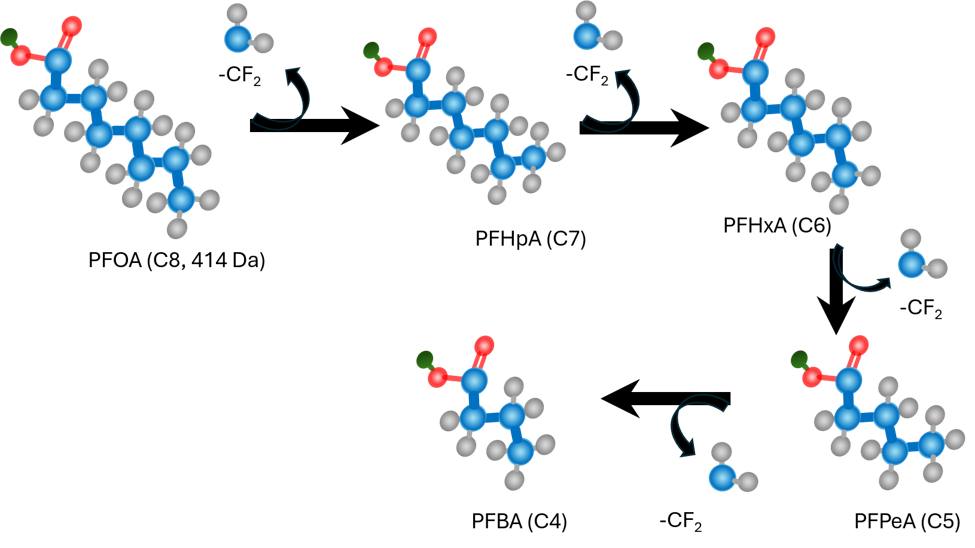
Figure 2: Breakdown of PFOA into its common breakdown products.
Monitoring only PFOA disappearance can miss persistent C7-C4 acids. Today, that requires liquid chromatography-tandem mass spectrometry (LC-MS/MS) — sensitive but slow, matrix-sensitive, and isomer-ambiguous without high-res MS and standards for every analyte. MRR takes a different angle, detailed on our molecular rotational resonance technology page, which detects molecules using microwave excitation of gas-phase molecules, measuring rotational transitions unique to 3D structure, isotopes, and dipole moment.
For PFAS, that means:- No chromatography — C4 through C8 each have distinct moments-of-inertia, even differing by only CF2.
- Conformer specificity — MRR resolves conformers as separate carriers, with fit metrics (OMC, similarity %, A/B/C diffs, dipole ratios).
- Quantum-first libraries — simulate then validate with one standard, then screen mixtures with a targeted headspace method.
These recent studies show that MRR can detect larger molecules, breaking the 400 Da milestone, which allows MRR to see the full C4-C8 series on one platform; parent disappearance and daughter ingrowth with the same instrument and library concept.
How Molecular Rotational Resonance Detects PFOA and PFAS
Peer-reviewed MRR studies show why MRR is a strong candidate for that job. Using a BrightSpec broadband MRR spectrometer in the 2–8 GHz range, Schilberg et al. (Chem. Phys. Lett., 2021) reported the first highly-resolved rotational spectrum of PFOA itself, assigning six distinct low-energy conformers guided by B3LYP-D3BJ/6-311++G(d,p) quantum chemistry [3,10]. The work revealed that PFOA adopts a helical conformation that minimizes fluorine–fluorine repulsion by maximizing spatial separation, including left-handed and right-handed helical forms and defined interconversion barriers, which are subtle geometry changes that give distinct rotational fingerprints without any separation [3]. Gollamudi et al. (2026) extended this to PFOA monohydrate, assigning 326 a-type and b-type rotational transitions to a single conformer and resolving K-splitting with exquisite sensitivity to conformational change in this large, weakly bound system [2,9].
That sensitivity is exactly what PFAS destruction monitoring needs. Traditional LC-MS/MS remains the gold standard for PFOA, and GC-MS can be effective with derivatization, but both rely on extraction, cleanup, and careful elimination of non-volatile matrix residues, plus specialized expertise and time-intensive sample prep [2,10]; they struggle to distinguish conformers, helical enantiomers, hydrates, and homologs differing by only CF2 without perfect chromatography [3,10]. MRR, rooted in broadband Chirped Pulse–Fourier Transform Microwave Spectroscopy pioneered by the Pate Group [11], relates measured rotational transitions directly to moments of inertia: any small change in 3D geometry produces a different fingerprint that can be identified and quantified directly in a mixture [11,12], including isomeric and structurally similar compounds demonstrated in complex-mixture work [13,14].
For fluorinated acids specifically, chiral-tag MRR has been used to assign absolute configuration of highly fluorinated carboxylic acids [15]. For the breakdown ladder PFOA → PFHpA → PFHxA → PFPeA → PFBA, that means each daughter acid, plus its conformers, can be told apart on the same instrument, with the same physics model [2,3].
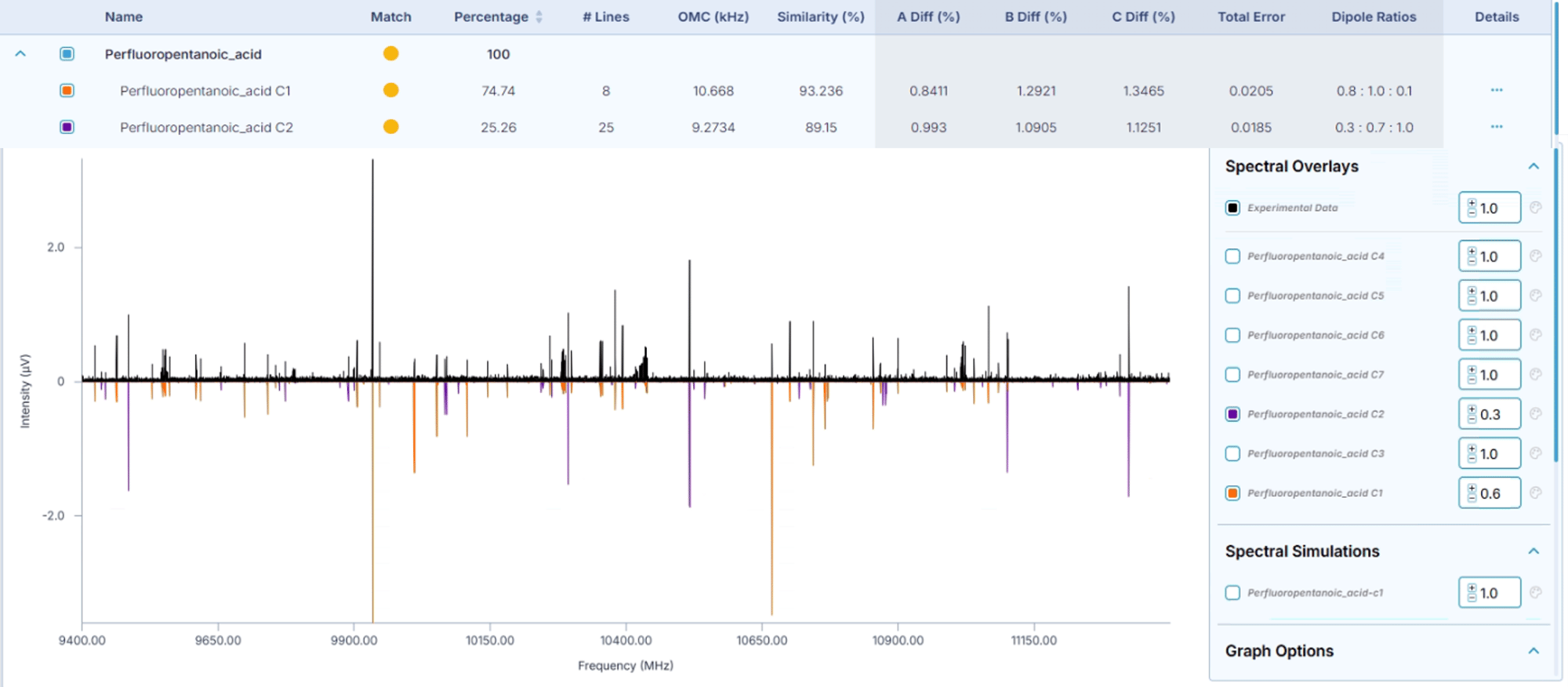
Figure 3: This is an example of the alignment of an experimental sample of perfluoropentanoic acid (black spectra) and its two theoretical conformers (orange and purple) in the BrightSpec Edgar software. This figure shows how sensitive MRR is to different bond angles that are present in the two conformers shown and can detect and quantify the amount of perfluoropentanoic acid in subsequent samples.
This matters because partial destruction is not detoxification: if a thermal, hydrothermal, plasma, or electrochemical process only shortens the chain, the C7–C4 daughters left behind are themselves persistent perfluorocarboxylic acids. Understanding and differentiating those breakdown products, rather than just watching PFOA disappear, is how we prove true mineralization to CO2 and fluoride.